
You've typed the message three times, deleted it three times, and still haven't said what you mean. Maybe you're holding your phone outside their building, or sitting beside an unfinished guitar recording that sounds more nervous than romantic. A love confession song can help when ordinary words feel too small, but only if it carries a clear, personal message. The song should make the feeling easier to share, not hide the confession behind pretty production.
The Moment That Makes You Want a Love Confession Song
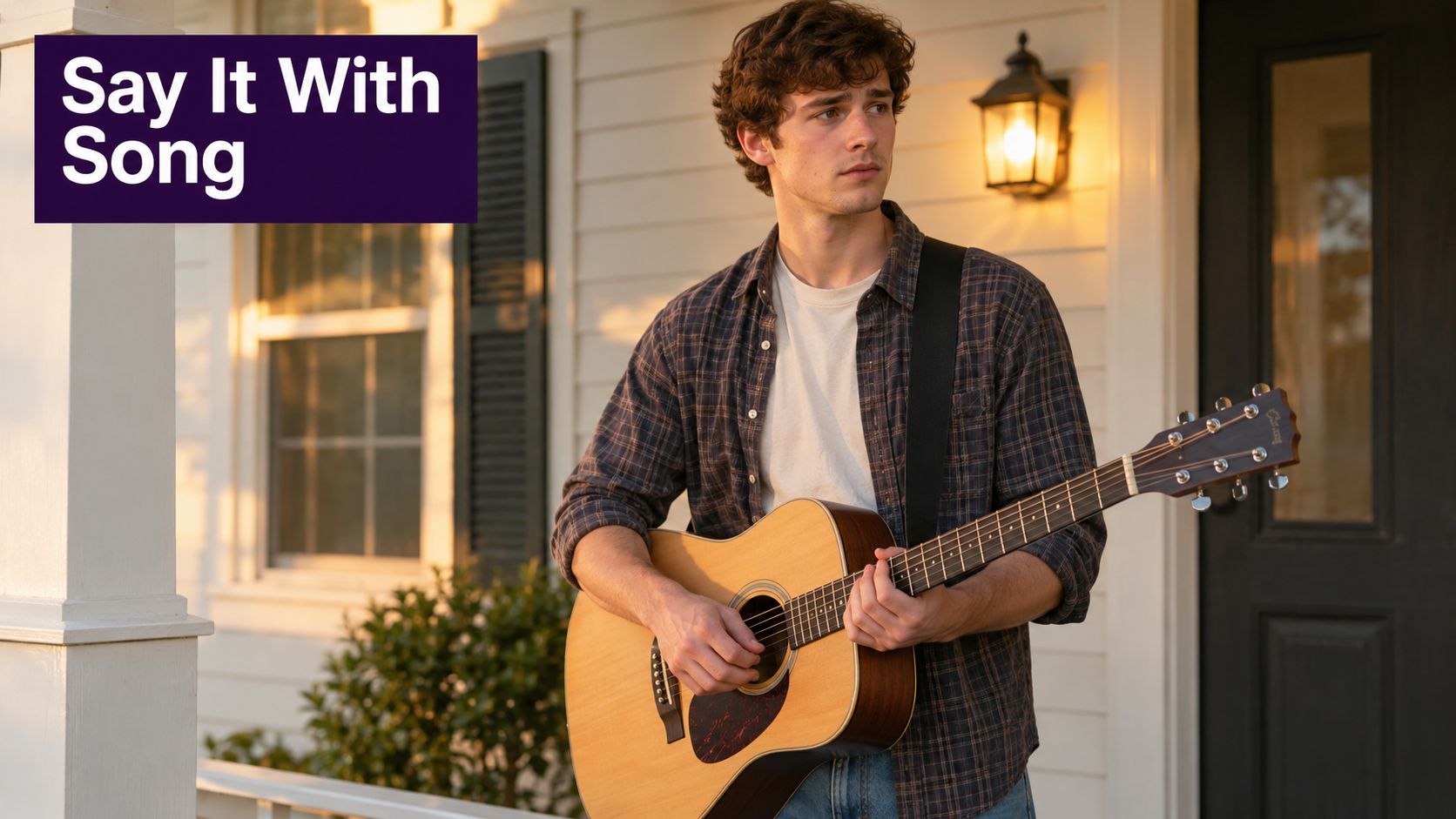
At seven in the evening, the porch light is already on. You've got a guitar across your knee, although you've played the same four chords so many times that your fingers have stopped noticing them. Your phone sits on the step with a draft message open: “There's something I've been meaning to tell you.”
You could send it. You could knock. Instead, you keep thinking about the small moments that made the feeling impossible to ignore, the coffee they bring you without asking, the joke they repeat when you're anxious, the quiet ride home that felt better than the party itself.
A song becomes appealing at that exact point because it gives those details somewhere to live. It lets you say, “I remember us,” before saying, “I want us to become something more.” That personal quality matters far more than whether you can sing perfectly or produce a polished arrangement.
The central rule: Treat the love confession song as a message first and a song second.
Romantic confession through music has deep roots. The Sumerian “Love Song for Shu-Sin,” dated to around 2000 BCE, is commonly traced as the oldest known love song, connecting modern romantic songwriting to a tradition that began in Mesopotamia rather than in the pop era. This historical overview of love songs also places romantic lyricism within later troubadour and courtly-love traditions.
That history explains why the format still feels natural, but tradition won't rescue a vague lyric. A song filled with “forever,” “beautiful,” and “you complete me” may sound romantic while telling the listener almost nothing about your relationship.
The useful question isn't, “Which famous love song should I send?” It's, “What do I need this person to understand when the song ends?” Answer that first, then build the music around it.
Getting Clear on What You Actually Want to Say
Before choosing a melody, write the confession as one ordinary sentence. Don't search for a rhyme. Don't make it sound like a chorus. Say what you would tell the person if they were sitting across from you and you had no music to soften the moment.
Maya thought she wanted to write about the trip she and Jordan took to the coast. When she sat with the feeling, she found the message was smaller and more frightening: she wasn't afraid of losing the big adventure, she was afraid of losing their coffee-shop mornings. That sentence gave her a direction no generic declaration could provide.
Ask four questions before you write
What do they need to hear?
Is it “I love you,” “I want to take this relationship seriously,” “I've fallen for you,” or “I'm ready to stop pretending this is casual”? Choose one. A confession song becomes weaker when it tries to cover every possible feeling.What haven't you said out loud yet?
This is usually the line with the most emotional charge. Perhaps you haven't admitted that you plan your week around seeing them, or that their absence changes the feel of an ordinary room.How should they feel after listening?
Aim for one emotional destination. You might want them to feel cherished, reassured, surprised, understood, or invited into a future with you. Don't demand that the song create every emotion at once.What detail belongs only to the two of you?
Use the wrong turn on your first date, the chipped blue mug, the argument about which song belongs at number three on a playlist, or the phrase they say when they're pretending not to care. Specificity creates recognition.
Turn the answers into an anchor
Maya's sentence might become: “I want Jordan to know that our ordinary mornings have become the part of my life I most want to keep.” Every later decision should support that thought. A gentle arrangement fits. A lyric about routine fits. A dramatic breakup-style chorus doesn't.
The songwriting guidance from Berklee makes the same practical distinction between concrete, personally addressed writing and broad romantic language. Listeners don't always interpret lyrics exactly as the sender intends, so say the message aloud before or after the song.
Write your anchor sentence on a note. If a lyric, genre choice, or vocal performance doesn't serve it, remove it. A clear confession doesn't need more decoration. It needs fewer competing ideas.
Writing Lyrics That Sound Like Your Story
Sam and Priya don't need a song about moonlight, destiny, or an unnamed perfect love. Their story already has better material: a rained-out rooftop, a playlist argument about song three, and Priya stealing the blanket before either of them falls asleep.
Those details can carry a complete confession because they let Sam show what love feels like in their actual life. The listener doesn't have to admire an abstract promise. They can recognise a shared world.
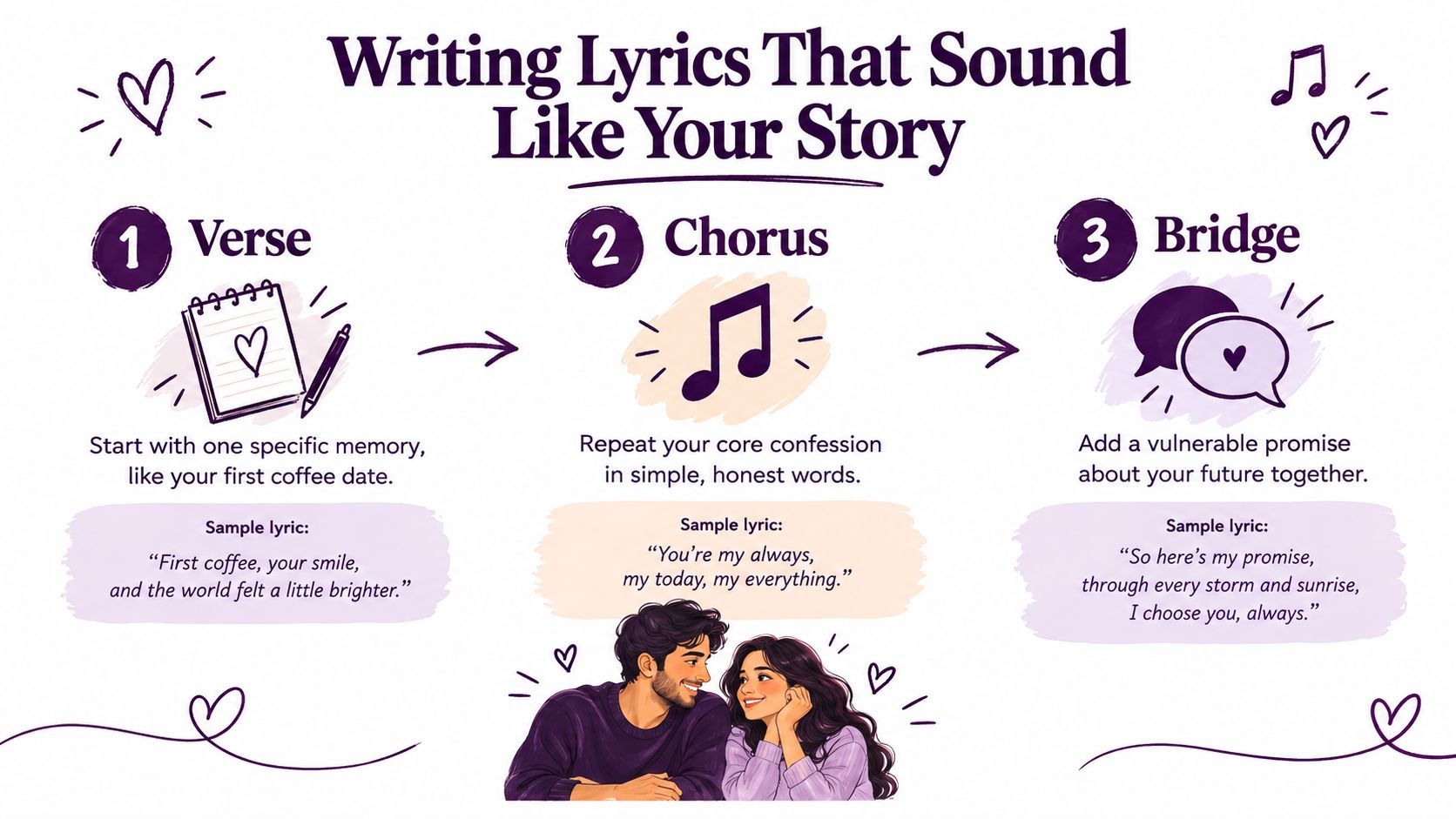
Build the verse around a scene
The verse should place the listener somewhere specific. Use short lines and concrete nouns.
Rain on the rooftop, nowhere to go
You laughed at the weather, I lost my coat
We argued for hours about song number three
And somehow that night felt like home to me
This works because the scene gives the emotion evidence. “You're amazing” tells Priya almost nothing. “You laughed at the weather” tells her Sam remembers how she changed an inconvenient night.
Songwriting guidance from TailorTune's practical lyric-writing framework recommends a verse for the scene, a chorus for the memorable statement, and a bridge for a tonal shift or escalation. Its suggested working ranges are 4 to 8 lines per verse, 4 to 6 lines per chorus, and 2 to 4 lines for a bridge. Treat those as useful boundaries, not laws.
Let the chorus say the thing
The chorus shouldn't make the listener solve a puzzle. It should state the emotional centre plainly.
I love the life that happens in between
The missed trains, cold coffee, and borrowed sleeves
You steal the blanket, then pull me close
It's the little things I never want to lose
The phrase “I never want to lose” is the confession's clear turn. The surrounding lines explain why it matters, but the chorus carries the sentence Sam needs Priya to remember.
Keep one main emotion in each section. The verse can feel fond and observant. The chorus can feel open. The bridge can carry fear.
Use the bridge for vulnerability
The bridge is where Sam admits what he's been avoiding.
If I say I'm scared, will you stay near?
I don't need a perfect answer
I just need you to know
I'm choosing you from here
That shift gives the song a human risk. It also prevents the arrangement from becoming a loop of praise. Read every line aloud. If you wouldn't say it in your own voice, change it until you can.
Fill in this template tonight:
- Verse: “I remember when we __________.”
- Chorus: “What I'm trying to tell you is __________.”
- Bridge: “What scares me is __________, but I still want __________.”
Don't add five verses to avoid writing the honest line. One vivid scene, one direct chorus, and one vulnerable admission will usually carry more weight than a long catalogue of compliments.
Choosing How the Song Gets Made
The right production route depends on what the confession needs to sound like. Someone who plays guitar casually may create the most moving version at home. Someone who has never recorded a vocal may lose the emotional point while worrying about timing, pitch, and microphone placement.
| Factor | DIY Recording | Personalised Song Service |
|---|---|---|
| Time | Requires writing, recording, editing, and retakes around your own schedule | Handles much of the production workflow after you provide the story and direction |
| Equipment | Works with a phone or basic home setup, though room noise and uneven volume can remain | Uses arranged production and a prepared vocal performance |
| Musical ability | Best suited to someone comfortable singing or playing an instrument | Suitable when you want the message without needing to perform it yourself |
| Voice | Keeps your actual voice, including nerves and imperfections | Lets you choose a produced vocal approach that supports the lyric |
| Cost | May be inexpensive if you already own what you need, but your time is part of the investment | Adds a service cost, while reducing the amount of recording work you must do |
| Emotional effect | Raw, intimate, and unmistakably personal | More finished and controlled, with lyric polish, arrangement, vocals, and mastering handled for you |
A non-musical person working toward a confession in two weeks should not promise themselves a studio-quality recording from scratch. Writing the lyric, learning the melody, finding a quiet room, recording usable takes, and fixing distracting sounds can turn a meaningful gift into a stressful project.
A casual guitarist has a different advantage. If the person they love treasures the singer's voice, a slightly shaky recording may be the point. The missed chord and nervous breath can communicate effort more directly than a flawless vocal.
Where a custom track fits
A personalised song service such as GiftSong can turn supplied memories, names, occasion details, and mood into a short produced song, with lyric writing, arrangement, vocalist, and mastering managed as part of the process. That route suits a last-minute gift when the message matters more than personally performing every note.
The practical trade-off is simple. DIY gives you authorship in the performance. A service gives you help with craft and finish. Neither choice is automatically more romantic.
If the confession depends on sounding polished, hand it off. If it depends on sounding unmistakably like you, record it yourself.
Don't choose a grand cinematic arrangement for a quiet relationship unless that scale reflects how you speak. A small acoustic track can suit a private first confession. A fuller production can work for an anniversary, proposal, or public celebration, but the lyric still needs to sound like the person giving it.
Planning the Moment You Share It
The same song can feel tender, awkward, or overwhelming depending on how you deliver it. Pick the format based on the listener's comfort and the kind of response you want, not on what looks most dramatic online.
Live in person
Live sharing fits a couple who already talks openly and enjoys intimate gestures. You might play the song in a living room after dinner, on a quiet walk, or at the place where you first realised the relationship had changed.
Lower the performance pressure before you start. Say, “I made something for you, and I want you to hear what I'm trying to say.” Then play the track, sing it, or hand over headphones if playing an instrument would distract you from being present.
Choose a comfortable seat, reduce background noise, and avoid turning the moment into an audience event unless the recipient likes public attention. A confession should give them room to react without feeling watched.
Recorded video
Video works well for long-distance relationships, a gift sent before a special date, or a confession you know you'll rush if you deliver it live. Film yourself speaking briefly before the song, show the singer performing, or combine the audio with photographs and lyric overlays.
Keep the build-up short. A video that takes too long to reach the song can make the recipient anticipate a speech instead of feeling the surprise. Under three minutes usually creates a focused experience, especially when the song itself is the emotional centre.
Record in a quiet room and test the final file on the device your recipient is likely to use. A beautiful vocal won't help if the opening explanation is hard to hear or the lyrics disappear against busy visuals.
A surprise share page
A private share page is useful when you want the recipient to listen alone and replay the song later. Send the link shortly before a planned moment, such as when they arrive home or open a small parcel. Don't drop it into a random text at two in the morning and expect the emotional timing to survive.
Pair the digital reveal with something physical. A handwritten note can say, “Listen when you have a quiet minute,” without explaining the whole confession. The note creates anticipation while leaving the song space to speak.
Keep the reveal simple: good lighting, a quiet background, a clear opening line, and enough time for the listener to respond.
Check their schedule before sending anything important. Don't choose the moment they're commuting, working, or surrounded by friends unless that setting is part of the surprise. Production should support the confession, never bury it under animated effects, excessive text, or a long introduction.
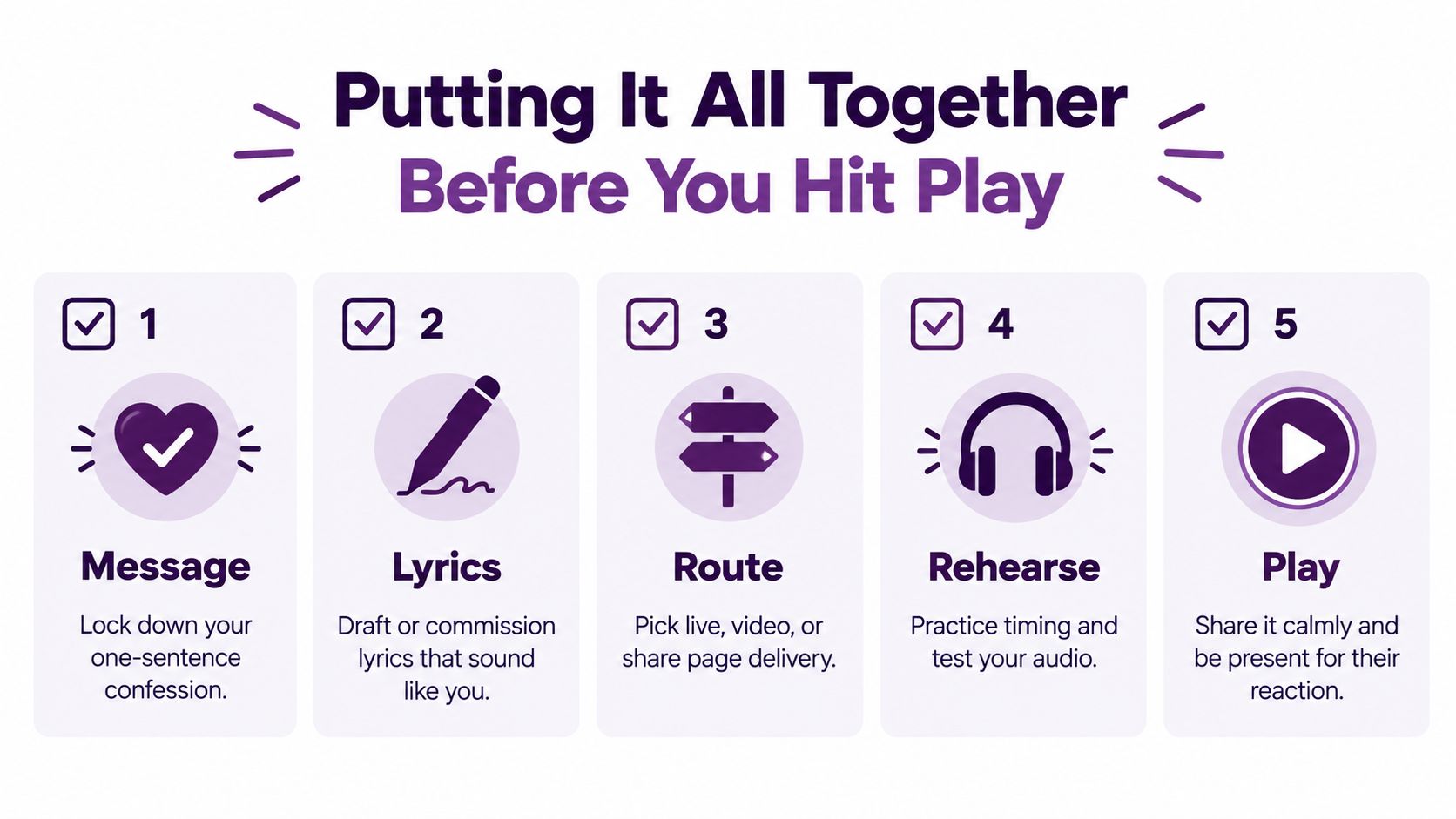
Putting It All Together Before You Hit Play
You don't need to solve every creative decision at once. Use a short sequence and make each choice serve the sentence you wrote at the beginning.
Your working checklist
- Message: Write the one-sentence confession. If you need several sentences to explain it, keep refining.
- Lyrics: Draft the scenes yourself or commission lyrics from the details you've collected. Keep the central line easy to hear.
- Route: Decide whether your voice, a recorded video, or a produced track best matches the relationship.
- Rehearse: Practice the handoff once. Test the audio on phone speakers and headphones.
- Play: Share the song calmly, then stop talking. Give the recipient time to feel and answer.
A few traps deserve a final check. Don't hide the key confession in the bridge, choose a sad arrangement for a hopeful message, or fill the lyric with explanations that belong in your spoken introduction. Don't wait until the perfect version arrives and let the actual moment disappear.
Do this, skip that
- Do one focused rehearsal: Practise how you'll introduce the song and how you'll stay quiet afterward.
- Do test the file: Listen on the device your recipient will probably use.
- Do protect the personal detail: Make sure the shared memory is audible and understandable.
- Skip the approval committee: You don't need to read the entire lyric aloud to friends for permission.
- Skip the extra verses: More lines won't fix an unclear message.
- Skip the performance disguise: Don't turn a sincere confession into a music video so elaborate that the recipient loses sight of you.
A love confession song is a vehicle for honesty, not a substitute for saying the words directly. After the final note, tell them what the song means, even if your voice shakes. They'll remember the care in the moment far longer than whether every chorus line rhymed.
If you want help turning your memories into a finished confession song, GiftSong can create personalised lyrics, vocals, and a shareable track from the details you provide. Visit GiftSong, add the moment only the two of you recognise, and give the song to someone who deserves to hear what you've been trying to say.
Ready to create your own?
Create your song